.svg)


Average Order Value: Why It Still Matters, Ways to Improve It, and How Extend Can Help

Ecommerce merchants like you don't always need more traffic or more customers (although both are objectively nice to have).
That probably sounds counterintuitive, right? But here’s the reality. In many cases, you need more revenue from your existing customer base. That means focusing your marketing efforts on boosting average order value (AOV).
A higher AOV can mean more revenue without a matching rise in cost.
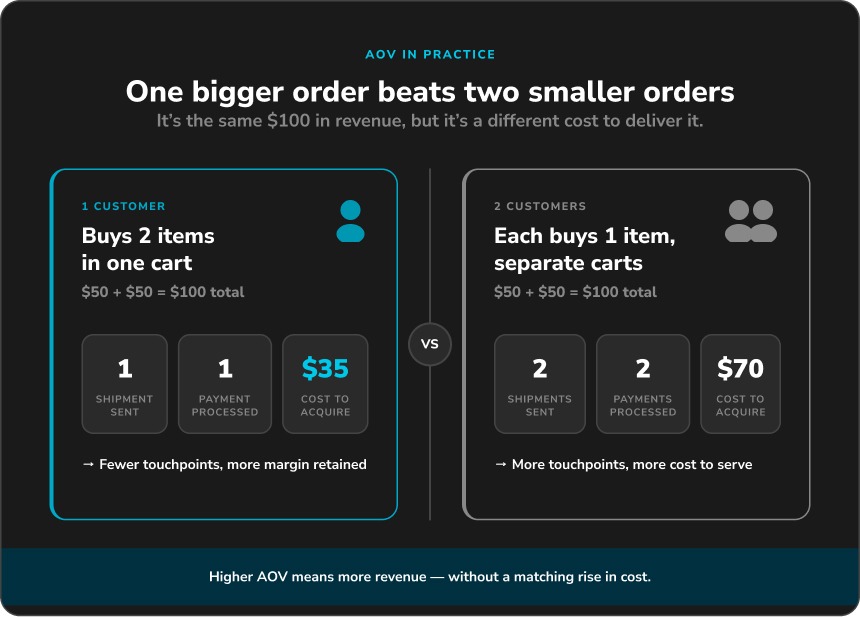
Consider two scenarios. In the first, a single customer buys two $50 items. In the second, two customers each buy a single $50 item. The first scenario could be a better deal for you. Here’s why:
- Suppose you spent $35 acquiring the customer who bought two $50 items in one transaction. You’ll make more money in this scenario than spending $70 to acquire two customers who each purchased a single $50 item.
- Payment processing fees typically apply to the number of transactions. Fewer transactions equal slightly lower processing fees.
The bottom line? AOV is one of the key metrics for ecommerce businesses, alongside customer lifetime value (CLV). This article walks through what AOV is, why it matters, and the strategies boosting that metric today.
What is average order value (AOV)?
Average order value is an ecommerce metric that tells you the average amount a customer spends in a single transaction. It’s less a measure of customer loyalty (which CLV monitors) and more of a read on transaction health.
Why does a company’s average order value matter?
A high AOV can improve profit-to-cost ratio. When transaction amounts are higher, more profit survives after covering the fixed costs of that transaction, including customer acquisition costs, payment processing, and fulfillment.
AOV tends to matter most for merchants selling higher-priced products that require more customer consideration, like home goods, electronics, and furniture. Shoppers who buy a sofa online likely won’t buy one again for a while. So while you have them on your site, you need to make the most of those transactions.
But say your business model leans more on one-click checkouts across social media channels. There's less room to upsell or cross-sell mid-transaction, both of which are common tactics to raise AOV. In these cases, high volume and low AOV may simply be the nature of that channel.
Now say you succeed in boosting AOV. Any gains here can be wiped out by a poor post-purchase customer experience. Inefficient customer service requiring more time from agents, return fraud, and poorly handled claims of loss or damage can erode improved margins. Even worse, these lapses give customers a reason to shop at a competitor.
AOV strategy and post-purchase strategy are now part of the same conversation.
What is the average order value formula?
Add up the value of every order in a specific time period, then divide by the number of orders in that same period.
Current AOV = total revenue ÷ total number of orders
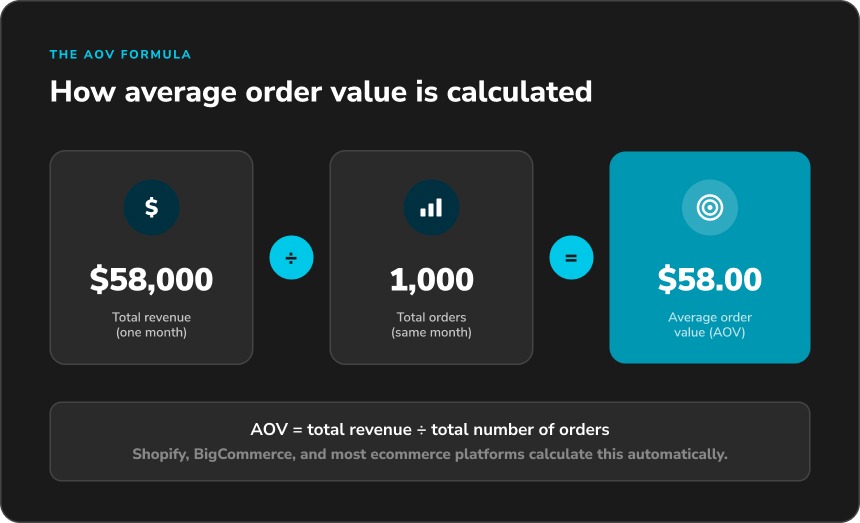
Popular ecommerce platforms like Shopify and BigCommerce calculate it automatically.
How to increase AOV in today’s marketplace
Some leading effective ways to increase AOV today include:
- Leveraging customer data to create more personalization at key touchpoints;
- Leaning into loyalty programs; and
- Entering into partnerships that add customer value while sharing revenue.
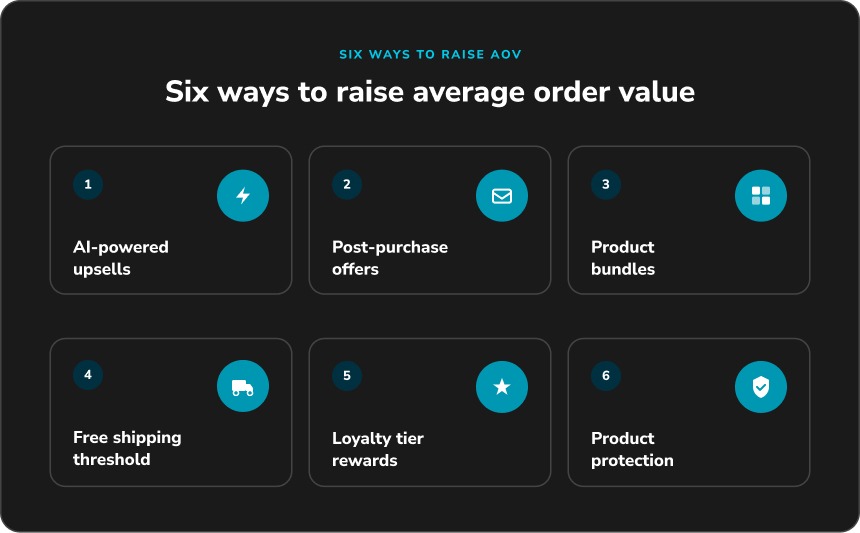
Here are six top tactics that follow from this strategy.
#1: Let AI hyper-personalize product recommendations.
Product recommendations are a classic and still-effective way to boost sales. 2025 research from Attentive bears this out: “77% of [surveyed] consumers say they're likely to purchase from a brand when they get relevant product recommendations (83% for Millennials).”
But what if you could make product recommendations even more relevant? The days of rules-based recommendations (“if cart contains X, suggest Y”) are giving way to behavior-based recommendations, thanks to AI.
AI can help you mine customer data to make recommendations hyper-relevant, making it more likely a customer will add to their cart, boosting AOV. Here are just some of the data points that AI-powered recommendations can use:
- What John is viewing now.
- What customers who also viewed what John is viewing have purchased.
- John’s purchase history.
- What your highest-margin complementary products are.
- What your most popular products are, regardless of margin.
- What your most popular product bundles are.
If John is a loyal, repeat buyer with an extensive history, you might recommend an item he purchased a year ago and might need again. In the same color and size. And you can nestle these recommendations on product pages he frequents.
If John has no purchase history, you might recommend your most popular, high-margin related products with a small discount to nudge the additional purchase.
Sample AOV calculation
Suppose your ecommerce store handles 1,000 orders per month which equals $58,000 in total revenue.
You add an AI-driven recommendation which gets clicked and added to 15% of orders, averaging a $25 add-on.
- Extra revenue: 1,000 × 15% × $25 = $3,750.
- New total revenue: $58,000 + $3,750 = $61,750.
- New AOV: $61,750 / 1,000 = $61.75 (a 6.5% lift).
#2: Turn post-purchase touchpoints into a second checkout.
Your AOV-building efforts don’t end when the shopper clicks “Buy.” The order confirmation and shipment tracking pages are prime real estate for last-second product add-ons.
An order doesn’t ship the moment a customer clicks “Buy,” so a well-placed "add this now for 15% off" offer on these pages can lift incremental AOV without adding friction.
Sample AOV calculation
Assume the same baseline of 1,000 orders per month and $58,000 in total revenue.
You add a “Don’t Forget!” post-purchase offer on a $30 item at 15% off ($25.50 each). Eight percent of customers (80 orders) take the offer.
- Extra revenue: 80 orders × $25.50 = $2,040.
- New total revenue: $58,000 + $2,040 = $60,040.
- New AOV: $60,040 / 1,000 = $60.04 (a 3.5% lift).
#3: Build on your most common order value as a baseline for bundles.
Your “most common order value” is the cart size most of your customers check out with. In many cases these carts contain the same product combination. Use this order value and product combination as benchmarks for creating AOV-boosting bundles.
Suppose a hair-care brand looks at their ecommerce platform’s backend and notices that shoppers frequently purchase a smoothing brush and a detangling treatment together. Try bundling those items with a complementary, margin-rich product into a more expensive kit, giving shoppers a good reason to spend more in a single transaction.
Sample AOV calculation
Suppose you’re a home goods company and notice that 300 of your 1,000 monthly orders consist of a $35 candle plus a $30 diffuser refill ($65 total). You bundle both with a $20 complementary item into a $100 “Home Refresh Kit.”
Those 300 orders without the add-on would generate $19,500 in revenue (300 × $65). The other 700 orders average $50, contributing $35,000. Total revenue is $54,500 and AOV is $54.50.
But say 60% of that group of 300 (180 orders) upgrade to the $100 kit instead of the $65 pairing. The remaining 120 still buy the pair separately.
- New revenue from that segment: (180 × $100) + (120 × $65) = $18,000 + $7,800 = $25,800 (vs. $19,500 before, a $6,300 gain).
- New total revenue: $35,000 + $25,800 = $60,800.
- New AOV: $60,800 / 1,000 = $60.80 (an 11.6% lift).
#4: Offer volume discounts and free shipping thresholds.
Volume discounts continue to work because they give shoppers a clear reason to spend more:
- “Spend $X and get free shipping”; or
- “Spend $X and get Y% off your order.”
Free shipping is arguably the most powerful incentive for increasing AOV. As recently as 2024, FedEx’s Ecommerce Merchant Report reported that “81% of shoppers will add more items to their order to get free shipping.”
And of course, the margins on the products required to meet the threshold should be more than sufficient to cover ground shipping costs.
Sample AOV calculation
Suppose you charge a $9 flat shipping fee for orders under $75 and offer free shipping at $75+. Roughly 400 of your 1,000 monthly orders land in the $60-$74 “near-threshold” range.
Before you offer any free shipping threshold, your 1,000 monthly orders generate $52,000 in revenue with an average order value of $52.
Once you promote “Free shipping over $75”, 70% of those near-threshold shoppers (280 orders) add roughly $20 in extra merchandise to qualify.
- Extra revenue: 280 × $20 = $5,600.
- New total revenue: $52,000 + $5,600 = $57,600.
- New AOV: $57,600 / 1,000 = $57.60 (a 10.8% lift).
Let’s not forget that free shipping has a cost. This cost varies depending on the items shipped. Heavy, bulkier items like sofas cost more to ship than a t-shirt. Subtract these costs from the new total revenue achieved after launching your AOV-boosting promotion. Now you’ll have a better read on the actual AOV lift.
#5: Reward customer loyalty program members with tiered perks.
Well-designed loyalty programs may incentivize spending by offering more attractive perks at higher tiers of membership. Similar to free shipping thresholds, point-based loyalty programs show members how much more they have to spend to earn enough points to qualify for higher tiers.
And it works. According to the 2025 Deloitte Consumer Loyalty Program Survey, “Most consumers (72%) say loyalty programs make them more likely to spend with their preferred brand, while over half (56%) increase their spending because of the program.”
Skincare brand Riversol offers a three-tier program that takes customers through Bronze, Silver, and Gold levels. Customers can earn points for every dollar spent and redeem them for unique products.
Powered by Shopify loyalty app Smile.io, Riversol determined their loyalty program members “spend 11x more than non-members and have 7x higher AOV than non-reward members.” Say a member has to spend only $10 more to qualify for a free moisturizer unavailable to non-members. For many members, that might be too tempting an incentive to ignore.
Sample AOV calculation
Say you revamp your loyalty program and launch Bronze, Silver, and Gold tiers.
A member sitting at 380 of the 400 points needed for Gold — which unlocks a free gift — could see a checkout nudge: “Spend $4 more to unlock Gold.” She adds a $10 item to be safe. Assume a baseline of 1,000 orders generating $52,000.
Once you’ve implemented the new program, 300 of those 1,000 orders come from loyalty members near a tier threshold. Twenty-five percent of those shoppers (75 orders) take the nudge and add an average $10 to their orders.
- Extra revenue: 75 × $10 = $750.
- New total revenue: $52,000 + $750 = $52,750.
- New AOV: $52,750 / 1,000 = $52.75 (a 1.4% lift).
#6: Offer Extend Product Protection.
Extend Product Protection can safeguard freshly arrived ecommerce products from accidental damage. Depending on the item, this damage can include a dropped and busted electronic, a pet-stained rug, or a spilled glass of wine on a couch.
Shoppers purchase a protection plan at checkout, and merchants earn a portion of every protection plan sold. This revenue share is close to pure profit, since Extend absorbs the costs associated with underwriting and claims.
When Monster Transmission added product protection to eligible purchases, the brand saw a 120% increase in conversions on those items. Because product protection can help reduce the perceived risk of buying an expensive transmission, shoppers were more willing to complete the purchase.
Even better, product protection holders get access to automated claim resolution. Plan holders file a claim online, answer a few questions, and often receive a claim decision in a matter of seconds. And if they need to speak to a human agent, they have access to an Extend-managed call center, further protecting your profit margins.
Sample AOV calculation
You start selling a premium blender line averaging $180, and add a two-year Extend Product Protection plan at $25 per unit at checkout.
Assuming 500 blender orders per month, that’s $90,000 in revenue on the blenders alone (500 × $180). Your AOV is $180.
Now assume a 30% attach rate (150 of 500 orders) on the Extend protection plan.
- Extra revenue: 150 × $25 = $3,750
- New total revenue: $90,000 + $3,750 = $93,750.
- New AOV: $93,750 / 500 = $187.50 (a 4.2% lift).
Note that this example excludes any revenue share on the sales of product protection.
Improve AOV and customer satisfaction with Extend
Seamless, self-service claims experiences often determine whether a customer buys from you again. So with product protection, you’re not only boosting AOV. When plan holders return to your online store to buy again, you stand to boost customer lifetime value as well.
And if you use product protection within Extend’s comprehensive Shopper Operations platform, you get a suite of tools that manage other loyalty-building post-purchase experiences.
From order tracking to returns, Shopper Operations also includes an intelligence layer that segments customers automatically by their order history and fraud risk. For example, suspected fraudsters experience friction, while top spenders might enjoy free returns.
Contact us today to learn how product protection and Shopper Operations can help increase both AOV and CLV.

Aaron Sullivan is content and copy director at Extend. He specializes in writing about e-commerce, finance, entertainment, and B2B SaaS.















.avif)


