.svg)


How Dynamic Customer Segmentation Maximizes ROI and Builds Loyalty

Customer segmentation has been part of marketing strategies for a long time — even before the dawn of ecommerce. But that list of VIPs you generated three months ago may no longer be as relevant due to the volatility of today’s ecommerce shopper.
These shoppers are clicking on more products and placing more orders, but they’re spending less. For the first half of 2025, an impact.com study of 1,554 North American brands shows “clicks increased 18% and orders rose 12% [YoY], yet [consumer] spending grew just 0.4%.”
Why? Shoppers are taking more time to browse and research before they click the buy button. They want deals and care less about loyalty. “True” brand loyalty — defined by SAP Emarsys as “unwavering, unshakeable, and built on trust, love, and devotion to a brand” — declined to 29% in 2025 from 34% in 2024.
What if you could keep “wavering” shoppers on your site with personalized messaging generated from real-time behaviors? That’s where dynamic customer segmentation comes in.
In this article, we’ll define and explain how to implement dynamic customer segmentation (if you haven’t already) to achieve profitable personalization at scale.
What is dynamic customer segmentation?
Dynamic customer segmentation is the practice of grouping and communicating with your customer base using real-time data points. Think of it as sending the right message to the right audiences at the right time.
It’s the opposite of static segmentation models, in which you create customer segments manually and expect to use them for days, weeks, or even months.
You still have a role in dynamic customer segmentation. You set guidelines and rules that an integrated tech stack then uses to continuously evaluate customer behavior. Customers automatically move in and out of segments like these:
#1: “More than two past purchases, no site engagement in the last 30 days.”
Your response: Send an email or SMS featuring product offerings that complement what they’ve purchased. Include a small discount or, depending on the price, offer to pay for ground shipping.
#2: “Viewed product at least three times in seven days but no purchase.”
Your response: Serve a retargeting social media ad featuring the viewed product.
#3: “Resolved a product protection claim in the last 90 days and purchased again in the last 30 days.”
Your response: Invite them to join your loyalty program, which comes with embedded product protection after a certain number of orders.
You decide, for example, what a churn risk looks like. Then your tech stack takes over, using multiple data sources to identify specific customers who fit the profile you set. Those data sources can include:
- Real-time behavioral data: items viewed, abandoned shopping carts, wish list, app usage, customer support interactions.
- Transactional data: order history, AOV, channels used to purchase items, return frequency.
- Lifecycle stages: first purchase, churn thresholds, subscription milestones.
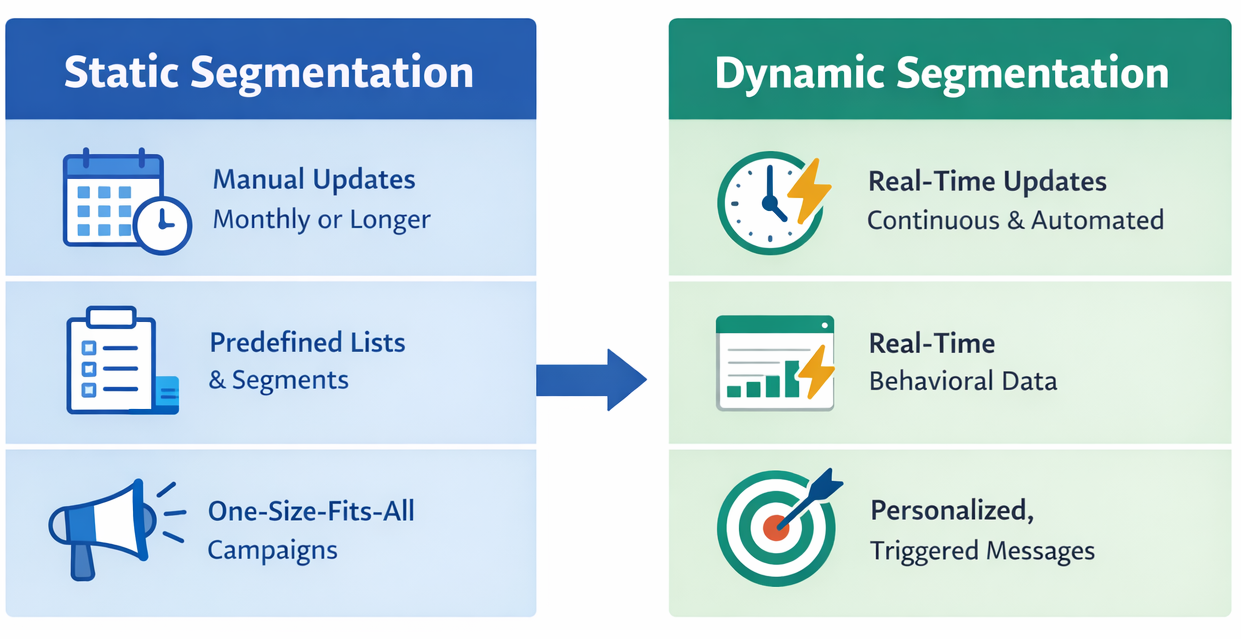
But suppose you’ve had success with static customer segmentation as a lifestyle marketer. Why should you invest in dynamic customer segmentation? Better personalization.
And when customers get what they believe to be personalized content from brands, they spend more. In a 2024 study, Deloitte found that “80% of consumers surveyed prefer brands that offer personalized experiences and reported spending 50% more with such brands.”
The building blocks of dynamic customer segmentation
To realize the numerous benefits of dynamic customer segmentation, you need three building blocks:
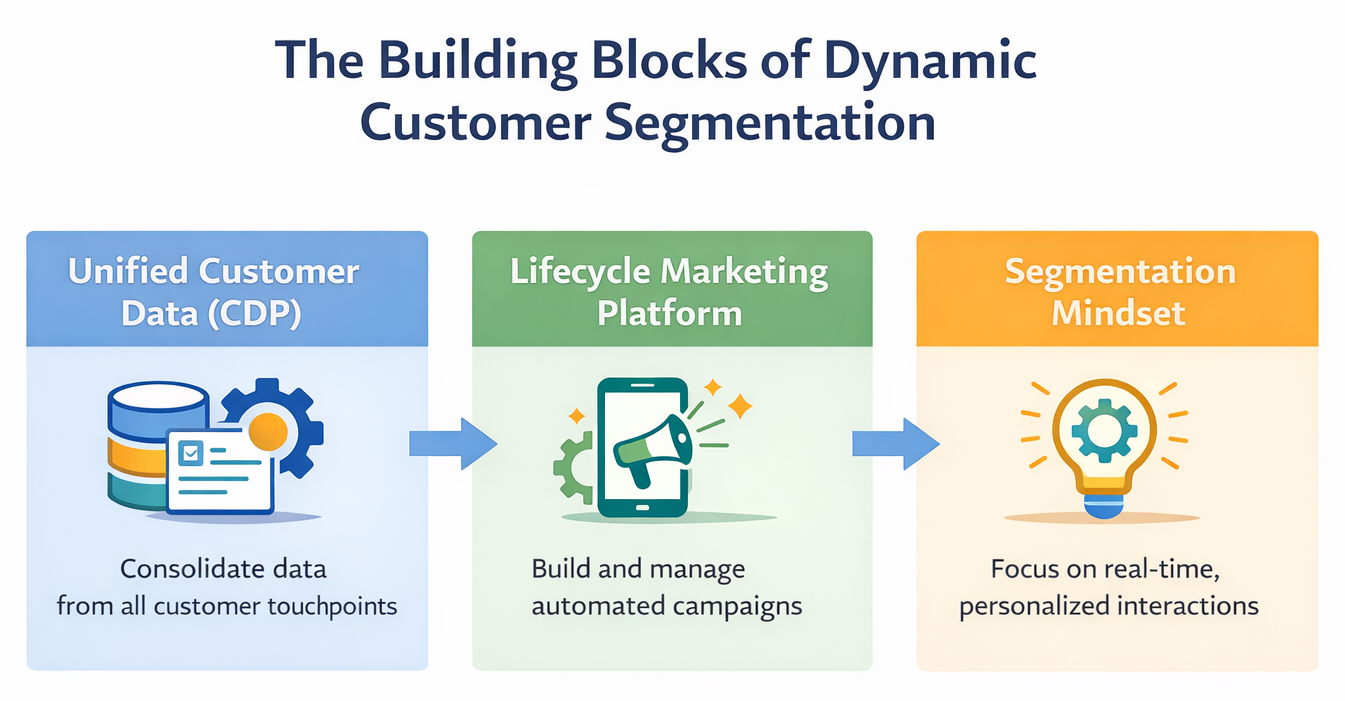
Let’s define these building blocks and see how they work together to boost conversion rates and customer satisfaction.
#1: Unified customer data
Fragmented data is the enemy of dynamic customer segmentation.
For example, you wouldn’t market to a high-value customer who makes frequent returns the way you would to a similar customer with no return history. If you process ecommerce sales and returns in different systems, these systems need to talk to each other for dynamic segmentation to function properly.
Most brands solve this problem with a customer data platform (CDP). A CDP pulls in the most current data from touchpoints like your site, app, support, and email service provider, and creates unified customer profiles from these touchpoints, allowing you to segment more granularly.
A CDP isn’t a data warehouse. The latter collects and stores large volumes of historical and current data from various sources (like sales, marketing, and operations) for analysis, reporting, and business intelligence.
But CDPs can use data from a warehouse to create customer profiles for personalized marketing. Think of data warehouses as libraries and CDPs as librarians that pull the best resources to help someone conducting research on a specific topic.
Because the CDP is so critical for dynamic customer segmentation, consider the following before you make a selection:
Favor tools with out-of-the-box ecommerce integrations.
The cost for a CDP goes way up if you have to build one or more integrations with your existing systems. Klaviyo’s CDP, for example, offers seamless integrations with ecommerce platform Shopify, help desk provider Zendesk, and Google Ads, to name a few.
Evaluate latency.
Dynamic customer segmentation depends on the rapid analysis of real-time data. Your understanding of “real time” might differ from that of the CDP provider.
Make sure you establish how quickly the CDP can analyze customer behavior and then deploy the marketing campaigns you’ve set up.
Consider the scale of your business.
If you have an enterprise-level or rapidly scaling business, you might already use a data warehouse like Snowflake. In these cases, consider a CDP like Hightouch, which deploys insights from this data across many tools for more complex, multi-touch journeys.
Smaller ecommerce companies can consider platforms like Klaviyo, which combines a CDP, marketing capabilities, and an analytics dashboard.
#2: Lifecycle marketing platforms
These software partners are the “segment hubs” where you can do the following:
Stitch together segments using all the fields and events from your CDP.
An event is an action a user takes like a page view or purchase. A field is a user attribute like a name or email. The CDP tracks events and connects them to user fields, giving you rich customer profiles.
When users engage in new events, their profiles evolve. As their profiles evolve, lifestyle marketing platforms move users in and out of the segments you create.
You can even tie a marketing campaign to each segment. A move to a new segment means the user will be the recipient of new or different marketing messages.
Apply AI-driven predictions to segment creation.
Many lifestyle marketing platforms like Klaviyo, Braze, and Iterable now use artificial intelligence and machine learning to generate dynamic segments for you.
For example, Klaviyo lets you describe what a churn risk looks like, and then it creates a segment that includes those criteria. These criteria could include the following:
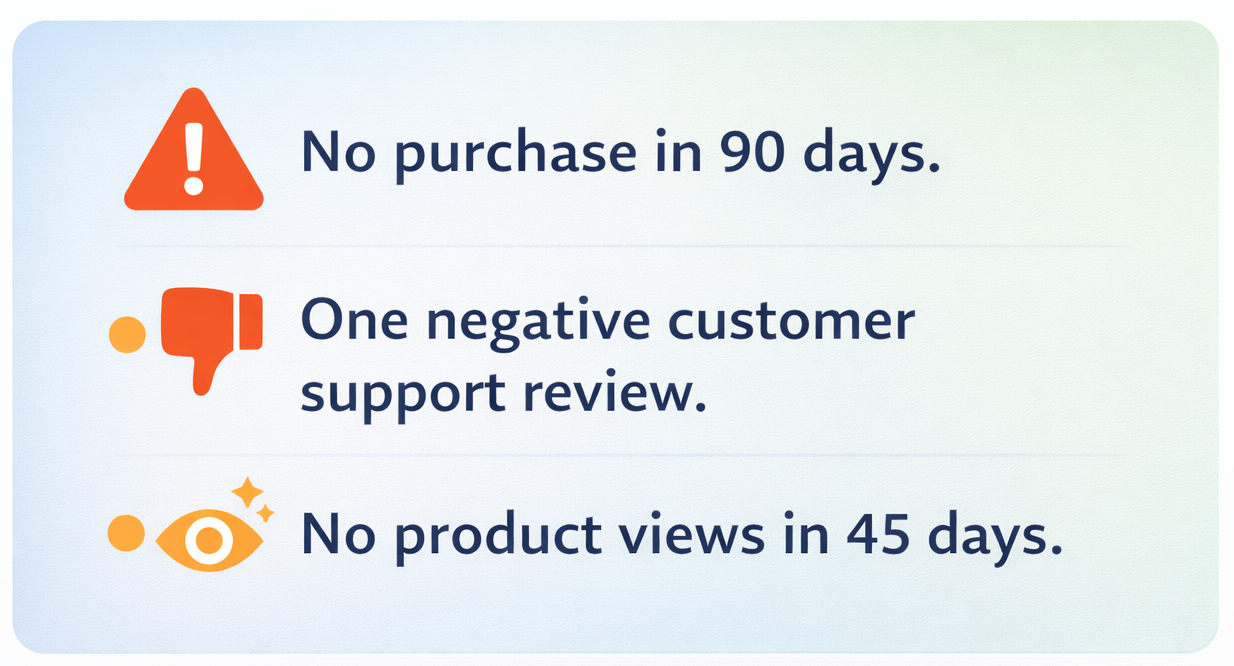
Iterable also uses AI to create a journey designed to re-engage the customer, which you can edit before deploying. If churn rates continue to increase, you can refine the segment and customer journey until you achieve the desired result.
#3: A segmentation mindset
If you have a segmentation mindset, you have the ability to curate meaningful customer journeys from marketing and commerce data, including the often overlooked — but highly valuable — post-purchase experience.
Consider post-purchase experience provider Extend, which manages returns, exchanges, and claims connected to product and shipping protection. These “events” can feed rich signals about customer-experience quality, risk, and loyalty back into your segments.
Here are just a few of those rich signals:
- Whether the shopper opts in to product or shipping protection (and for which SKUs).
- The value and frequency of protection offerings purchased or included.
- Whether they ever file a claim, and on what products.
- Whether they come back to your ecommerce store to buy a replacement product after a claim.
- Whether the email address associated with a return has ever been flagged for fraud.
Use these signals to create dynamic segments that both your CDP and lifestyle marketing platform can work with.
Dynamic segments Extend helps you build
With Extend’s help, your dynamic segmentation goes way beyond what shoppers have bought or viewed online. You can now segment based on specific post-purchase behaviors — and your response to them. Here are some examples:
- Protection advocates. These shoppers add shipping and/or product protection at a frequency you set and have a high customer lifetime value. These individuals are prime candidates for a journey that leads them to your loyalty program.
- Claim-Inspired loyalists. Shoppers in this segment purchase a protection plan, have a claim processed and resolved quickly, and return to your store to make a purchase. This behavior signals a growing sense of brand trust. Encourage these customers to leave reviews of their Extend experience.
- Serial returners. There’s a difference between serial returners who could be behaving fraudulently and high-value customers who return frequently due to legitimate issues. Extend’s fraud detection capabilities help separate the two. You might waive return fees for legitimate returners with high lifetime values and ban the others from returning altogether.
- Shoppers in unpredictable delivery areas. For shoppers in unpredictable delivery environments, shipping protection isn't just an add-on — it's a strategic safeguard. By identifying those who haven't yet opted in, you can offer proactive "secure delivery" messaging that provides valuable peace of mind and fosters long-term brand loyalty.
Extend’s development team makes it easy to integrate our solutions with the tech stack that’s required for dynamic customer segmentation to function properly.
But is dynamic customer segmentation working?
Once rolled out, you can measure the success of your new dynamic segmentation strategy by consulting key metrics in your lifestyle marketing software. Here are four critical ones:
#1: Incremental revenue per recipient (IRPR)
This metric answers the question, “Did this dynamically driven customer journey generate incremental revenue compared to doing nothing?”
You’ll need a control group of customers who were not subject to a campaign generated from dynamic segmentation. Compare the incremental revenue from the control group to that from the group who received the campaign.
#2: Contribution margin per customer (CMC)
Unlike IRPR, CMC measures whether dynamic segmentation increases per-customer or per-segment profitability. Say you use heavy discounting in a campaign. Shoppers might purchase more items (higher IRPR), but the shipping costs associated with the additional orders might erode order value too heavily.
Poor CMC might suggest retasking your campaigns to depend less on discounts.
#3: Repeat purchase rate (RPR)
RPR measures the percentage of first-time buyers who place a second order within a certain number of days after their first purchase. Depending on your ecommerce vertical, 30, 60, or 90 days might be an appropriate timeframe.
Again, you’ll need a control group for this metric to have value. If more customers in your dynamic segment buy again within the timeframe you set compared to the control group, your marketing strategy is working.
#4: Unsubscribe rate
Obviously you want to keep this metric as low as possible. But if shoppers in your newly crafted segment unsubscribe at a higher-than-expected rate, it might mean that you’re sending too many notifications across the channels where your brand is active.
Adjust the cadence of your messaging, and see if your unsubscribe rate declines.
Make Extend part of your dynamic customer segmentation strategy
Dynamic customer segmentation can serve as a way to keep up with shoppers whose intent, budgets, and loyalty frequently change.
And when you add post-purchase signals to the mix — like protection opt-ins and return behavior — you unlock segments that reflect customer loyalty and fraud risk, not just on-site clicks.
That’s where Extend fits in. We analyze these critical post-purchase signals for more effective customer segmentation.
To learn more about Extend’s powerful tools and how they can improve customer segmentation, get in touch with us here.

Aaron Sullivan is content and copy director at Extend. He specializes in writing about e-commerce, finance, entertainment, and B2B SaaS.
















.avif)


