.svg)


Q1 Sales Don’t Have to Stall: Win Q1 with This Post-Holiday Ecommerce Strategy

It comes as no surprise to ecommerce brands that the holiday shopping season usually accounts for a disproportionate share of annual revenue.
According to government data cited by PYMNTS, ecommerce sales accounted for 17.9% of total Q4 US retail sales in 2024. For the full 2024 year, online sales as a share of total retail sales was 16.1%.
Ecommerce businesses like yours depend on the strength of Q4 to offset the revenue dropoff that tends to occur in Q1. The post-holiday slump is generally the result of consumer spending fatigue, returns processing, and replenishing popular inventory the holidays may have depleted.
Fortunately, you can still engage holiday shoppers in Q1. To keep the momentum going, you need a post-holiday ecommerce strategy that focuses on consumer psychology, segmentation, and personalization.
In this article, we’ll lay out a marketing strategy to help boost online sales and build brand loyalty — without depending solely on discounts.
Use Q4 data to personalize special offers in Q1.
You have a wealth of first-party customer data from the holiday shopping rush: what shoppers purchased, but also what they didn’t purchase. Analyze this data — and customer behavior — to personalize Q1 communications and drive conversions.
Market viewed but unbought items with “Treat Yourself” messaging.
Lean on abandoned carts and still-full wishlists from Q4 to fuel your Q1 campaigns. Then encourage your customer base to “treat themselves” to these items because after surviving the holidays, they deserve them.
“Treating yourself” is most common among Gen Z shoppers. Despite lower incomes, Bank of America found in a recent study that 57% of Gen Z “buy themselves a small ‘treat’ at least once a week.” There’s no indication this tendency subsides right after the holidays.
Suppose you maintain a wishlist similar to clothing brand H&M’s. The brand’s online store places a little heart at the top right of product pages, and “hearted” items end up on an easy-to-access list.
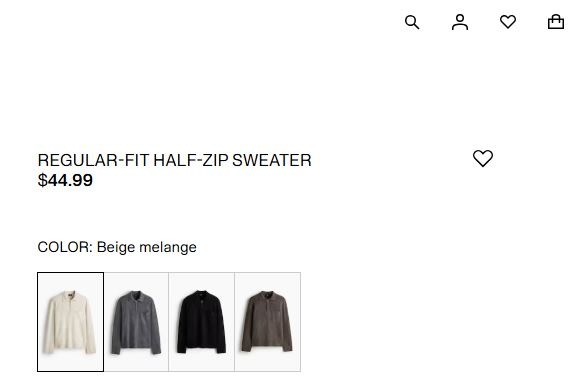
In January, encourage shoppers to treat themselves to their remaining wishlist items via owned channels like email marketing and social media ads. Do the same for items left in abandoned carts. Include a small, limited-time discount or offer to waive shipping at a certain spending threshold.
As an FYI, that familiar “new year, new you” messaging may have run its course, according to customer experience platform Persado. In a study of retail digital marketing campaigns between 2015 to 2022, “new year, new you” was the worst-performing phrase across channels when tested against other messaging. These channels included email, social media, and push notifications.
Tout the value and convenience of subscriptions.
Sometimes the greatest gift time-constrained shoppers can give themselves is convenience.
If you sell consumable goods needing frequent replenishment, consider offering subscriptions in Q1. Shoppers will never have to worry about running out of items that have become part of their daily routines, like vitamins or cosmetics.
Consider the cosmetics vertical. Future Market Insights projects the beauty subscription market to reach $16.42 billion by 2035, up from $1.55 billion in 2025. That’s a 25.9% CAGR. The study cites “convenience” as one of the key factors driving this growth.
If you already offer subscriptions, incentivize customers to join by paying for their first subscription month. The recurring revenue from subscriptions will soon pay for that complimentary month.
Subscription providers like Ordergroove integrate with the major ecommerce platforms.
Add value to loyalty programs.
Because Q4 sales are so important, you’ve likely incentivized your loyalty program members — in many cases your best customers — to spend more during the holidays. But you can still offer incentives in Q1 with refreshed tactics.
Make it easy for loyalty members to replenish their point totals.
Suppose you increase the value of loyalty points in December to encourage holiday spending. This tactic may not be effective in Q1 for two reasons:
- Members used all their points in Q4.
- Members are suffering from spending fatigue.
Rather than require another purchase to increase point totals, reward points for other easily trackable forms of customer engagement. For example, DIME Beauty rewards points for downloading their app, signing up for texts, and interacting with their social media platforms.
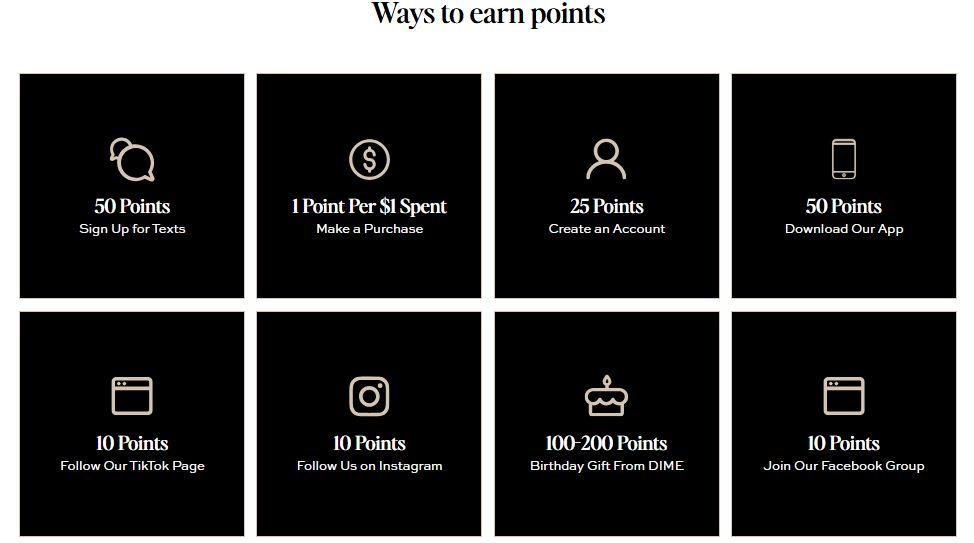
Companies like Yotpo offer ecommerce retailers multiple out-of-the-box reward campaigns to help loyalty program members replenish their points in this way.
Offer early access to Q1 product launches.
January is the critical Q1 month. First, you need to encourage loyalty program members to replenish their points in the ways mentioned above. Second, you should float early access to February and March campaign packages where they can use their replenished points.
Depending on your retail vertical, you might reserve February for Valentine’s Day promotions, and March for the release of new products or apparel collections.
The incentive here is early access, not deep discounts. Include several product bundles in your campaigns, where you can tout the value of buying multiple items together rather than separately.
Nail the post-holiday returns experience.
Q1 is the busiest time for returns. If you’re not ready for them, you risk forfeiting not only holiday profits, but customer satisfaction, as well.
According to a 2025 National Retail Federation (NRF) study, “Ahead of the [2025] winter holiday season … retailers expect 17% of holiday sales to be returned, consistent with previous years.” This number is higher than the expected return rate for the year (15.8%).
And the number of shoppers willing to ditch a retailer after a poor returns experience continues to grow. In the same NRF study, about “71% of consumers say they are less likely to shop with a retailer again after a poor experience, up from 67% in 2024.” Making matters worse, “four out of five said they will share their negative experience with friends and family, potentially amplifying the impact.”
You likely already know that free returns — which equate to discounting an unwanted item — are no longer an option across the board.
But what if you could grant free returns to some customers, and more restrictive return policies to others based on their history? With Extend Intelligent Returns and Exchanges, you can. Some examples:
- Your most devoted loyalty program members, with a limited return history, get a return on your dime in Q1, no questions asked.
- Customers with some purchase history get the option of an online exchange or a store credit equal to the amount of the unwanted product.
- Customers with no purchase history pay a return fee.
Extend is able to personalize returns based on two factors:
- Rules you set. For example, how great must a customer’s lifetime value be to qualify for a free return?
- A robust fraud detection model that recognizes fake names, email addresses, and phone numbers. Individuals attempting a return with one of these may be denied a return or face another prohibitive action like a return fee.
Whichever return option Extend determines appropriate, the seamless online experience will impress the customers you want to keep. And you’ll take a huge amount of pressure off your customer service team.
Add value to purchases with embedded protection offers.
Embedded offers are “value bundles.” Rather than discounting a product, you bundle its price with that of a value-added service. And if the perceived value is high enough, cash-strapped online shoppers are more likely to purchase the product.
Ideal value-added services for embedded offers include Extend Product Protection and Extend Shipping Protection. The former protects products against specific types of damage (including accidents) that occur during regular use, even after a manufacturer’s warranty expires. The latter protects packages against loss, damage, and theft.
Consider this example from Extend merchant partner Monster Transmission: by combining a small discount with a three-year Extend plan automatically included at no additional cost to the customer (on qualifying purchases), they were able to lift sitewide conversion rates by 120%.
Embedding the offers is a streamlined way to encourage conversion and help increase sales.
Include Extend in your post-holiday ecommerce strategy
Q1 doesn’t have to be a sales dead zone. By mining customer data and adding value strategically, you can keep the holiday momentum going.
By partnering with Extend, you gain the ability to nurture loyalty from your best customers thanks to personalized post-purchase experiences. You also gain access to value-added services that incentivize online sales. Discounting becomes optional, not essential.
If you want help adding personalized returns or embedded protection offers to your post-holiday ecommerce strategy, click here to contact the Extend team.

Aaron Sullivan is content and copy director at Extend. He specializes in writing about e-commerce, finance, entertainment, and B2B SaaS.


.jpg)