.svg)


Why Merchants of All Sizes Need Shopper Operations to Build Brand Trust

Brand trust is the foundation of customer loyalty. But it's getting harder to achieve, especially for enterprise merchants.
Business executives tend to grasp the importance of brand trust. PwC surveyed 548 of them in early 2024, and 93% agreed with the idea that “building and maintaining trust improves the bottom line.”
In reality, there's a huge gap between what these executives want and how their trust-building efforts are playing out in the market.
In a 2024 Pew Research Center study, only 29% of surveyed US adults said large corporations have a positive effect "on the way things are going in the country these days." That means more than two-thirds of adults have a bias against big companies, which can make building trust even more difficult.
So if you’re an enterprise ecommerce merchant, what can you do? There's not necessarily a single solution.
It takes a series of positive experiences for brand trust to take root. Increasingly, many of those experiences depend on what happens after checkout. To understand why, it's important to unpack brand trust further. We’ll start there, then recommend additions to your tech stack to nurture it across customer touchpoints.
What is brand trust?
Brand trust is the point at which a customer believes a merchant will continue to offer products and experiences that meet their expectations. This trust can take months to cultivate, and it can be lost after a single negative experience.
What are the threats to brand trust for merchants?
Whether you’re an enterprise merchant or just getting started, you may detonate brand trust if you appear impersonal, opaque in your policies, or treat all customers the same. It’s best to avoid these three threats at all costs.
Threat #1: Inconvenient or inefficient customer service
When shoppers reach out to customer service, they not only expect you to resolve their concern conveniently but also quickly. Fail in the first, and you discourage shoppers from the outset. Fail in the second, and you jeopardize consumers’ trust.
According to 2026 research from CX expert Shep Hyken, “65% of customers say convenience is more important than friendly customer service.” Convenience can mean you offer the following:
- Self-service options like AI chatbots and detailed FAQs.
- Email and phone access to real people.
- Software that tracks customer inquiries so they don’t need to rehash the situation each time they reach out.
And when you resolve their concerns quickly, customers perceive that you value their concerns. That’s an emotional connection. Brand trust grows. Again, Shep Hyken: “83% [of customers] trust a brand more when they are quick to respond to inquiries, questions, or problems.”
Threat #2: Poor communication of core values
Many enterprise merchants are or belong to publicly traded companies. For some consumers, "publicly traded" means these companies only care about profits. This perception makes it critically important for these merchants to publicize their commitment to key social issues.
Take the environment. According to the 2024 study from PwC, 41% of surveyed consumers said it's "very important for companies to disclose their environmental impact." But only 36% of surveyed business executives say they actually do that.
That's a communication problem, and it can tarnish a company's reputation.
Poor communication is also a threat when customer experiences don't match what's advertised. This problem afflicts large and small merchants alike.
Say you claim in a homepage banner that product returns are easy. But a loyal customer needing to return a shirt that doesn’t fit gets slapped with a stiff restocking fee. They call to protest the fee and have to wait for ten minutes for an agent to pick up.
That's not easy, and you’ll quickly lose their trust.
Threat #3: One-size-fits-all policies
The enormous cost of fighting and recovering from fraud has led many ecommerce merchants to subject all customers to strict policies, especially when they want to return items. These policies can include shorter return windows, restocking fees, and store-credit-only refunds.
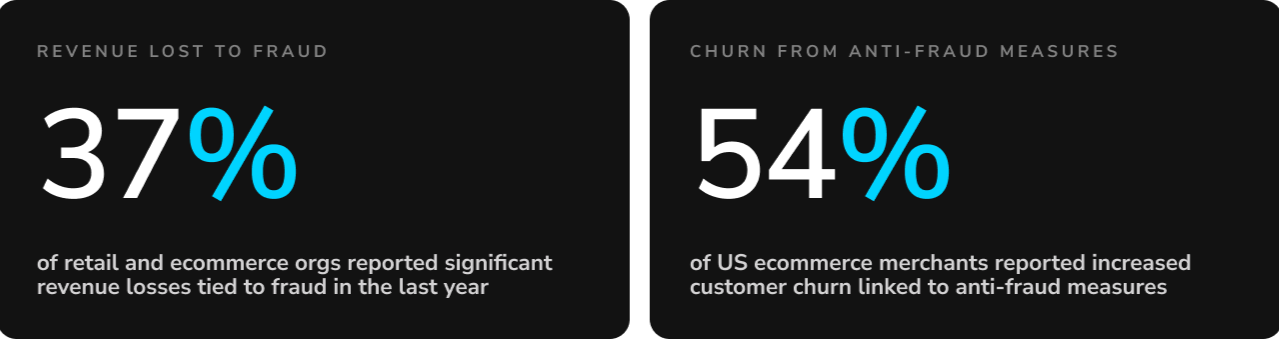
It’s easy to sympathize with these merchants when 2026 Lexis-Nexis data revealed “37% of retail and ecommerce organizations reported significant revenue losses tied to fraud over the past year.” The problem is strict, one-size-fits-all policies can damage brand trust.
One sentence later: “At the same time, efforts to strengthen fraud controls are contributing to customer friction, with … 54% of US ecommerce merchants reporting increased customer churn linked to anti-fraud measures.”
Blanket restrictions punish loyal customers right alongside bad actors. Treating every customer like a suspect can erode brand trust just as fast as a service failure. Merchants need a way to tell their best customers from their worst, and apply appropriate policies to each group.
What are the pillars of brand trust?
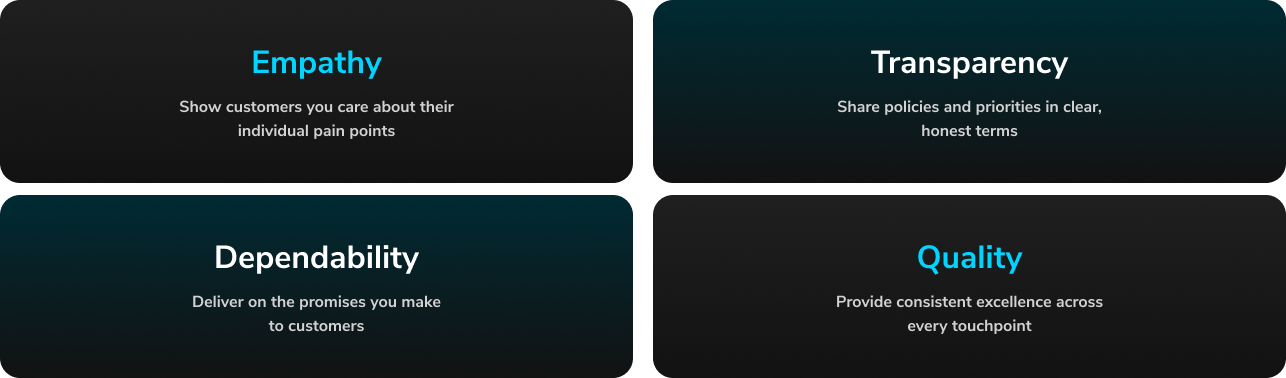
Enterprise brands wishing to boost brand trust need marketing strategies that resonate with consumers. If you’re a merchant wishing to boost brand trust, we recommend you craft marketing strategies founded on four common pillars.
Pillar #1: Empathy
You embody empathy when consumers feel that you care about them and their individual pain points.
This value plays out most often in customer service. An empathetic agent can calm an angry customer and hopefully give them a reason to buy again. (Agent friendliness is still important, even though many shoppers prefer convenient customer support.)
Consumers can also experience empathy through your self-service resources. Purple Mattress includes a comprehensive FAQ to answer many of the most granular (and personal) questions consumers might have:
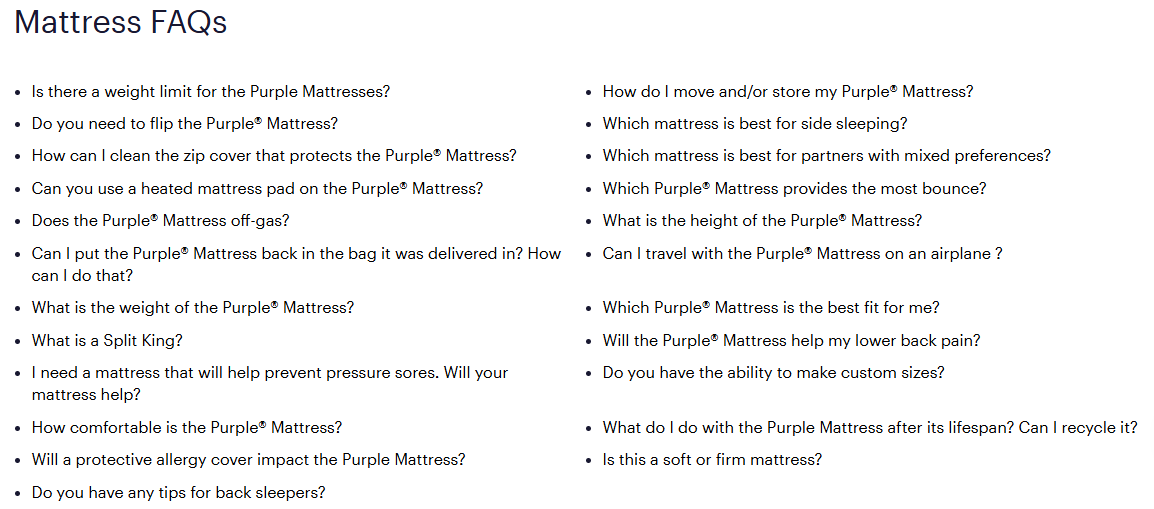
Such an extensive FAQ shows you care about customers' time. They no longer have to call or email customer service and wait for an answer.
Pillar #2: Transparency
Transparency is honesty. It means you, as a business owner, share your policies and priorities in easy-to-understand terms. And you make it easy for customers to locate this information.
A common concern for consumers — and one that touches brand trust — is how you use and protect customer data.
The booming fitness tracker market has raised the data-privacy stakes even higher. According to a 2023 Deloitte study, almost half (48%) of surveyed consumers using smartwatches or fitness trackers worry about security and data privacy on those devices. That's eight percentage points higher than it was in 2022.
Fitness tracker Fitbit includes this sentence near the top of their data-privacy policy statement: "We believe that transparency is the key to any healthy relationship." They write the rest of their policy in layman's terms.
Pillar #3: Dependability
Dependability and transparency go hand in hand. If you say you hold suppliers to a high ethical standard or that you work to minimize your environmental footprint, you need to deliver on your brand promise. That's the definition of dependability, and it grows brand trust.
The Dufresne Group Canada owns multiple furniture brands. One of their community initiatives is Dream Big, where they build beds for those in need and donate a portion of each mattress sale to the underserved. And they document that dependability.
Pillar #4: Quality
Consumers today expect brands to deliver quality at every touchpoint, whether through a product, service, or brand experience. If that quality is consistent across multiple customer interactions, it builds brand trust.
Here's an example. From its founding in 1999, Zappos has delighted millions of customers by making returns — among other things — a high-quality experience. Returns weren't just free; they were easy.
Now owned by Amazon, Zappos invites customers to drop off items at any UPS Store, where store associates process the returns.
To measure the impact of these and other initiatives on brand trust, Zappos uses a metric called Net Trust Score (NTS). They ask customers if they believe Zappos has their best interest as a customer in mind. At a 2023 conference, head of marketing insights Alex Gunov said the company's NTS was positive.
How can I grow brand trust?
Consistently good online experiences, which grow ecommerce brand trust, stem from your tech stack. So you add a platform to automate returns management, another for order tracking (“Where is my order?”), one more for shipping protection, and yet another for fraud detection.
Here’s the problem: even if each system delivers a consistent experience on its own, data can stay siloed. By the time your fraud detection tool flags a risky shopper and sends their data to you for review, they may have already been granted a free return.
Extend Shopper Operations solves this problem by unifying delivery (shipping protection, order tracking, and claim automation), returns and exchanges, and product protection into a single platform. Then a behavior-based decision engine called Shopper Intelligence analyzes data from each tool and applies personalized policies to customers in real time.
Here's how each tool embodies the pillars of brand trust and helps mitigate the threats merchants face.
Delivery: Anticipate customer needs before frustration sets in.
From the moment a consumer buys a product online, like a sofa, excitement begins to build. The customer starts thinking about how it will look in their living room and the comfort it will bring into their home.
A delayed delivery or a sofa arriving damaged can undo that excitement fast. Shoppers experiencing these issues will clog your customer support queues with WISMO ("Where is my order?") requests and demands for a repair. And if customers have to wait too long for a resolution, brand loyalty can wither.
Order Tracking, part of Extend Shopper Operations’ Delivery module, keeps shipping anxiety at bay. It keeps customers informed with merchant-branded tracking pages as well as SMS and email shipping updates.
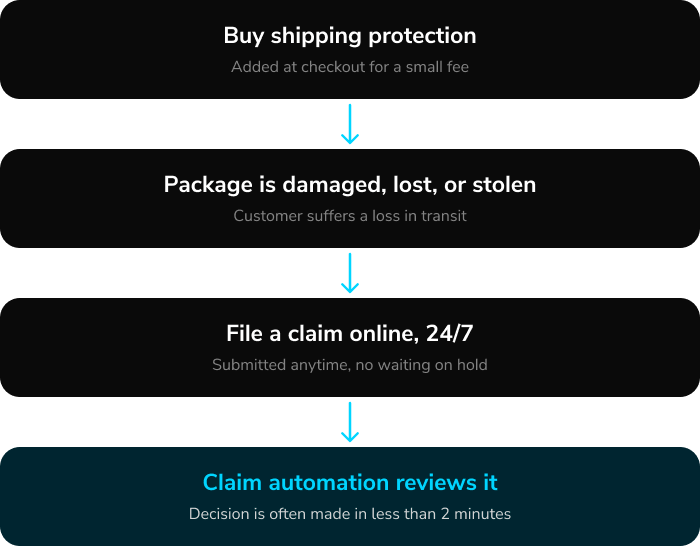
But if an on-time package arrives damaged, another tool in the Delivery module turns customer frustration over the damage into something positive. This tool is shipping protection, which shoppers can purchase for a modest fee at checkout. If the customer proves package damage, loss, or theft, they get a replacement at no additional cost.
Arguably better than the promise of a replacement package is the speed of the decision to approve the replacement. Customers who’ve suffered a loss can file a claim online 24/7 and receive an approval or denial in seconds. Known as Automated Claims, it has built-in fraud detection and spares brands like yours a support-team pileup behind the scenes.
Returns & Exchanges: Replace one-size-fits-all returns policies with fairness.
The only one-size-fits-all return policy that agrees with all shoppers is free returns across the board. But retailers like you know this could sink your business, since US consumers were projected to return $849.9 billion worth of merchandise in 2025.
With Returns & Exchanges, another Shopper Operations core tool, your recourse doesn’t have to be strict return policies across the board (which usually backfires). Your recourse can be fair policies across the board.
Suppose you’re in the apparel ecommerce vertical. Money-saving online exchanges can be your default return policy. Shoppers can easily swap a size, choose a different color, or pick an entirely new product. You keep the revenue from the original sale, and you keep the customer engaged on your site.
That's dependability and empathy working together. You're solving the customer's problem without treating every return request as friction. When Shopper Intelligence steps in, you can deny exchanges to high-risk customers while granting free returns to top-tier loyalty program members.
Returns & Exchanges empowers you to be more granular (transparent) in your published return policies. The offer of free returns to top spenders might encourage newer customers to shop more often. And the promise of restocking fees for potential bad actors could help keep this group out of your ecosystem.
Product Protection: Safeguard the product long after the sale.
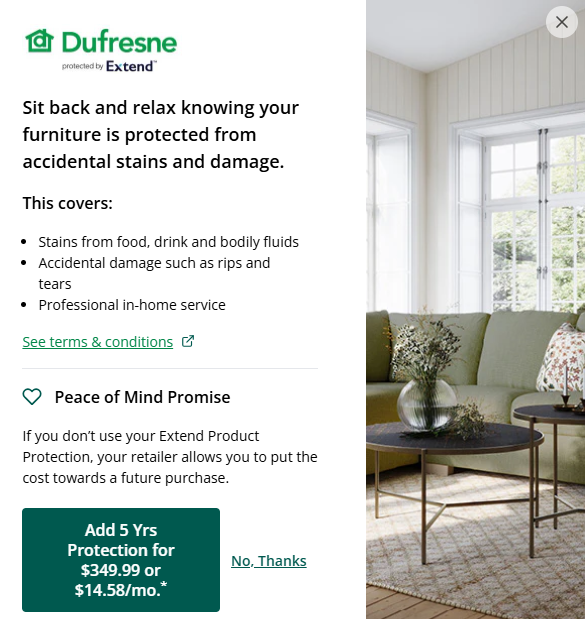
Product protection can safeguard products from accidental damage, including pet stains, a spilled glass of wine, a drop in the bathtub, and more. Shoppers purchase it at checkout, and you receive a portion of each plan sale. Both average order value and customer peace of mind increase. Like shipping protection, it comes with automated claim resolution.
It's also a proven conversion lever, and conversion itself is a trust signal. When Monster Transmission embedded product protection on eligible purchases, the brand saw a 120% increase in conversions on those items.
Product protection also helps you leverage transparency as a value. When you integrate your systems with Extend, you’ll be able to link to protection coverage information at the point of sale. A pop-up can then appear, letting shoppers know what the policy covers and what it does not.
The Shopper Operations suite: Encourage positive online reviews.
When a replacement product arrives quickly, an exchange goes smoothly, or a repair gets scheduled without friction, customers start to feel they can depend on your company. One positive experience after another sets up the customer to leave positive reviews.
In 2025 research, CX platform Yotpo learned a "great experience" motivated 64% of respondents to leave positive reviews.
These reviews generate social proof, which plants the seed of brand trust in new customers at the beginning of their customer journey.
Partner with Extend to build brand trust
Shopper Operations lays the foundation for repeat purchases by keeping the customer experience consistent from checkout through delivery, returns, and beyond.
And when the quality of that experience matches the promises in your marketing, customers start to trust that you'll keep showing up for them.
When you do keep your promises, you'll have more than a loyal customer base. Over time you'll have a community of brand advocates who’ll help drive customer acquisition with referrals.
Ready to see what Shopper Operations can do for your brand trust? Get in touch with the Extend team to learn more.

Aaron Sullivan is content and copy director at Extend. He specializes in writing about e-commerce, finance, entertainment, and B2B SaaS.


.jpg)