4 Consumer Electronics Trends + Related Challenges Brands Can Overcome

Every business leader wants to control costs and keep up with consumer preferences. But in today’s consumer electronics industry, a single disruption often makes it difficult to achieve both.
Consider these scenarios: a chipmaker redirects its manufacturing capacity toward AI servers, and suddenly the memory chip your smart speaker depends on is scarce and expensive. Or a new tariff takes effect, and your landed cost on a shipment jumps overnight. These disruptions can all wreak havoc on profit margins and projections.
The good news is you still don’t have to be one of the big industry players to adapt. Keep reading for four consumer electronics trends reshaping the industry today and actionable ways to respond to each.
Trend #1: The AI-driven component shortage
Supply chain disruption has been a consumer electronics trend since the pandemic. And though the semiconductor market is stabilizing, phone and computer manufacturers faced lead times of 2-50 weeks in Q4 2024, depending on the component required. Semiconductors allow microchips to process and store information. Phones, computers, and many smart home devices would be useless without them.
In recent years, artificial intelligence has fueled another wave of disruptions. Manufacturers of DRAM (dynamic random-access memory) chips are “steering capacity toward … data centers, where the margins are better, which leaves less for phones, laptops, and tablets.” DRAM chips store data temporarily when you start programs or switch between tasks on your electronic devices.
Increasing demand for AI technology has led to the worst DRAM shortage in roughly 15 years, causing DRAM prices to rise dramatically. The author predicted real hits to device shipments in 2026.
Solution: Leverage software with predictive intelligence and secure multiple suppliers.
How are major players like Apple responding to the DRAM shortage? Price increases. While you may have to do the same, there are other ways to offset the business impact.
First, deploy supply chain software that uses machine learning to flag disruptions before they hit. Platforms like Shippabo bring fragmented shipping networks under one roof. They combine real-time tracking with historical transit data to give you an accurate delivery picture and time to adapt your launch schedule.

Perhaps more important than logistics visibility is managing supplier risk:
- Lock in long-term supply agreements for DRAM rather than buying on the spot market. (The spot market is an open marketplace where small quantities of DRAM chips and modules are bought and sold for immediate delivery at current, fluctuating daily prices.)
- Line up two or three DRAM suppliers so a single delay doesn’t drastically stall your production line.
- Build safety stock specifically for DRAM, even if that runs counter to lean inventory instincts elsewhere in your operation.
While the above won’t fully restore supply chains, you’ll be able to more confidently schedule marketing activations and releases of new electronic products.
Trend #2: Smart home technology market growth meets cybersecurity certification
Smart home devices — also known as Internet of Things (IoT) devices — include Siri, Alexa, Google Assistant, online gaming consoles, smart TVs, and more. Research and Markets projects an annual growth rate of 6.4% for this vertical from 2026 to 2032. If you’re looking to enter this ecommerce category, be aware of two key consumer expectations:
- Interoperability. Consumers expect your smart appliances to work with devices from other companies. If a customer can’t control your cutting-edge smart lighting system with Alexa, the customer might not shop with you again.
- Cybersecurity. Bitdefender estimated in October 2025 that “home network devices face an average of 29 attacks on connected devices per day.” Some of these attacks compromise passwords and financial data and may even take control of the devices. Without reassurance that your devices are secure, shoppers might hesitate to purchase from you.
Interoperability used to be a selling point. Now, it’s a baseline expectation for smart home device developers to build interoperability through protocols like Matter, the cross-platform standard that lets smart home devices, like a smart refrigerator, work with Alexa, Google Home, and Apple Home.
Thanks to the FCC’s US Cyber Trust Mark program, IoT devices may soon be eligible for a cybersecurity labeling system. This voluntary certification, once formalized, will identify IoT devices that meet defined cybersecurity standards.
Solution: Treat certification as the new quality control baseline.
Consider taking the following steps to help ensure your new smart devices meet consumer and federal expectations.
- Prepare to complete the Cyber Trust Mark certification process, especially if your products could plausibly end up in a government, school, or enterprise procurement channel.
- Audit your product line for Matter certification gaps. If a competitor's device works across ecosystems and yours doesn't, that's now a basic feature gap, not a nice-to-have.
- Build cybersecurity approvals into your quality control process. Safety is already a top QC concern for most companies. Consider creating a similar process for cybersecurity.
Another precaution? Make sure your products allow automatic security updates and enable two-factor authentication for extra security.
Trend #3: Environmental scrutiny increasing
A growing share of consumers care about the environmental impact of their electronics, particularly among younger generations. And they increasingly base their purchasing decisions on that perceived footprint. In a 2026 Bain & Company survey, 92% of Gen Z respondents expressed concern about environmental sustainability. The same study showed that a surprisingly high percentage of Boomers — 77% — are similarly concerned about environmental sustainability.
Many brands settle for using recycled and recyclable components in the manufacturing process. While important, recycling isn’t enough to contain the rapid growth of electronic waste stemming from technological advancements and short product life cycles. Now the EU and several US states have implemented or are implementing “right to repair” laws to tackle this issue.
The EU directive gives consumers the right to request repairs from manufacturers at a reasonable price and within a reasonable timeframe. It extends warranty periods by 12 months when a repair is the solution, according to the seller’s legal guarantee. And it requires brands to keep spare parts available for a defined period after the last unit of a product is sold.
Member EU states were required to implement the directive by July 31, 2026.
In select US states, right-to-repair and extended producer-responsibility laws took effect at the start of 2026. According to Waste Dive, Colorado, Oregon, and Washington restrict “parts pairing,” or the practice of preventing non-manufacturer components from working. Similar laws are in effect or advancing in Texas, Minnesota, California, Nevada, and Vermont.
Solution: Design products for longer life cycles.
Modular laptop company Framework is an example of a business built around this shift. They design its products for durability and make it easy to repair and upgrade them.
Framework founder and CEO Nirav Patel told Energy Live News: “We’ve created an ecosystem and a marketplace around our products so that it’s not just use it, wear it out and then throw it away, it’s use it, repair it, upgrade it and then pass it on to someone else to use.”

Framework offers replacement parts in an online marketplace, ranging from memory expansion cards to keyboards. The company also helps customers service their computers with detailed DIY guides.
For other consumer electronics brands interested in prioritizing compliance readiness, it may be helpful to:
- Audit your product line against applicable US state laws and the EU directive to identify where your current design or documentation practices might fall short.
- Review parts and software locks that restrict independent or customer repair.
- Create a spare parts and documentation pipeline now, since several of these laws apply retroactively to products you’ve already sold.
Even if you can’t fully follow Framework’s example, you might still be able to extend life cycles by implementing another Framework initiative: offering gently used products at lower prices.
Trend #4: Little relief from the high cost of goods
The triple threat of inflation, tariffs, and (as we noted earlier) AI-driven component shortages are forcing consumer electronics merchants to make difficult decisions about pricing and profits. Either raise prices and risk sending customers to a competitor, or absorb a chunk of the higher costs and watch profit margins shrink. Here’s the reality:
- Inflation. The US inflation rate was 3.7% at the end of September 2026, up from 3.4% in August 2026.
- Tariffs. According to the Consumer Technology Association, “consumer technology importers paid $23.5 billion in tariffs in 2025 — more than five times the prior year ($4.0 billion).”
- Memory shortages. See Trend #1.
While raising prices to some degree given these conditions might be inevitable, you can help offset these costs with the following tactics.
Solution #1: Work with suppliers that practice lean manufacturing.
Lean manufacturing is a business philosophy that seeks to lower production costs by reducing waste. Suppliers that practice lean manufacturing will likely be able to sell components or finished products at lower prices — which means you as a retailer won’t necessarily have to raise prices as much or absorb as many costs.
The waste that lean manufacturing seeks to stamp out includes underutilized employees, excess components taking up space in a warehouse, and supply chain delays. It leans on five core principles, many of which can also apply to the way merchants conduct operations:
- Value. Ask yourself what customers really want from your products. If your core product has undesired features, you’re wasting money on the components behind those features.
- Value Stream. Once you understand what customers value, remove any waste in the processes required to deliver that value.
- Flow. Maintain accurate supply and demand planning. Too many or too few components on hand disrupts manufacturing, leading to employee idleness.
- Pull. Determine when customers most want or “pull” your products so you’re not increasing warehousing costs by stockpiling materials. For example, if you manufacture waterproof speakers, you might notice that demand spikes at the start of summer, not the holidays.
- Perfection. Whatever processes you put in place to drive the first four principles, create an analytics dashboard to monitor them and adapt your processes.
Bear in mind that a perfectly lean organization doesn’t actually exist; it’s always a work in progress.
Solution #2: Contain costs with shipping and product protection.
Package theft, damage during shipping, and accidental product damage in the home can jeopardize the cost savings you gain from lean manufacturing. Shipping and product protection can help offset these losses and boost profit margins.
Say the family cat knocks two new smart speakers off the table, breaking them. Or a highly anticipated package gets stolen from your customer’s doorstep. The most common customer reflex is to ask you for a replacement. You have two options:
- Replace or repair the product at a loss. You eat the cost of the product and any shipping fees.
- Refuse to replace or repair the product. You lose the customer and eat the cost of acquiring that customer.
You can avoid both scenarios by offering shipping and product protection.
Customers can purchase a plan while shopping online. If they experience a covered loss, their product would be eligible for repair or replacement, depending on the scenario. You save money and simultaneously save customers the frustration of a bad experience.
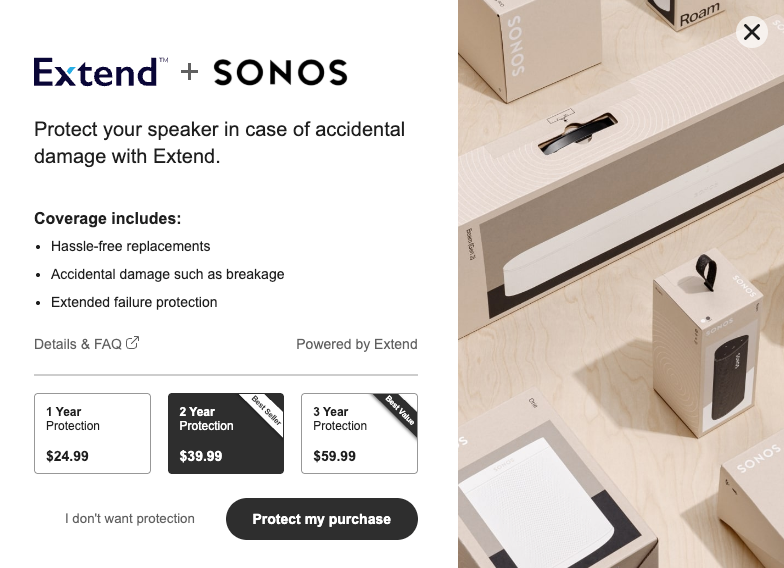
Better yet, customers needing to file a claim can do so online and receive a response within minutes. The user experience is so customer friendly it becomes a genuine competitive advantage.
Face consumer electronics trends more confidently with Extend
Facing all of the above trends at once is a lot for any consumer electronics brand to manage alone. You can’t control AI's appetite for DRAM, the next tariff schedule, or a state legislature’s repair mandate.
But you can control how well you're protected against what those disruptions leave behind: damaged shipments, costly replacements, and warranty claims that eat into margin. Extend Product and Shipping Protection won't fix a chip shortage, but they can help prevent any customer fallout from post-purchase damage.
If you’re still unsure how product and shipping protection can benefit your consumer electronics brand, read this article answering common objections.

Aaron Sullivan is content and copy director at Extend. He specializes in writing about e-commerce, finance, entertainment, and B2B SaaS.