.svg)


How Shopper Intelligence by Extend Powers Better Ecommerce Customer Segmentation

Ecommerce customer segmentation is the backbone of personalized marketing efforts. You leverage customer data to send the right message at the right time to the right people with the goal of boosting sales revenue. This is nothing new.
What is new is using advanced customer segmentation to safeguard the incremental revenue your personalized marketing strategies add to your online store. This evolution is critical due to the likelihood of ecommerce fraud.
Ecommerce fraudsters or bad actors can drain your business of this revenue both from their shopping behavior and from the cost of manual fraud detection. According to 2025 LexisNexis research, “US merchants [incur] an average cost of $4.61 for every $1 of fraud.”
Extend built Shopper Intelligence to tackle this problem head on. First, we use advanced analytics and AI to evaluate a shopper’s behavior and combine that with merchant-specific data points. Shopper Intelligence then uses these inputs to power a smarter customer segmentation model. Shoppers who’ve exhibited suspicious behavior get flagged, while honest shoppers get sorted based on order history.
Fraudsters encounter friction, while honest shoppers enjoy the benefits of personalization. In this article, we’ll explore five different customer segments Shopper Intelligence creates and how they fuel dynamic policies across the customer journey.
The Five Core Segments of Shopper Intelligence
Shopper Intelligence establishes five core customer segments based on common characteristics. You can then create policies that address the specific needs of each segment. These policies deploy automatically and consistently across key customer touchpoints thanks to Extend’s AI-powered commerce platform, known as Shopper Operations.
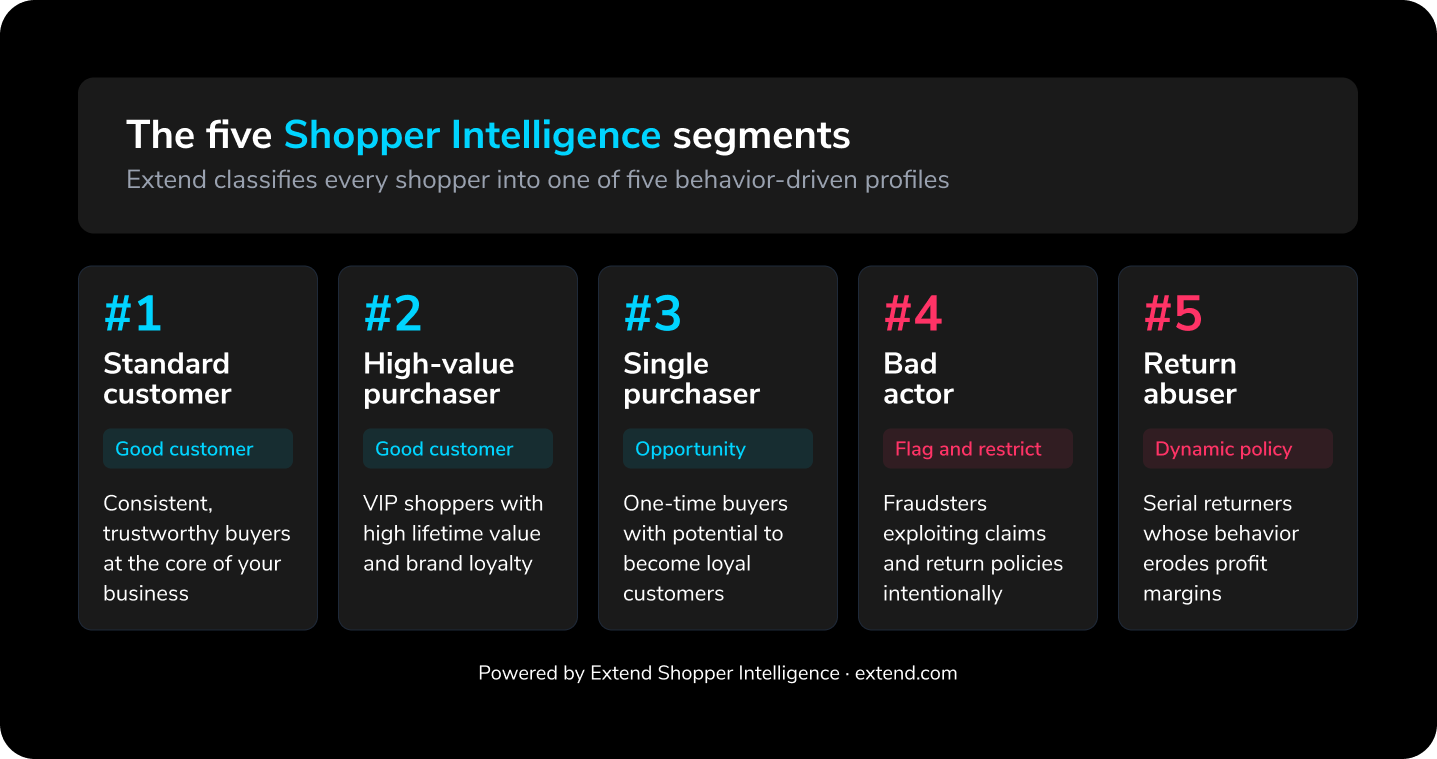
#1: The “Standard” Customer
“Standard” customers are your bread and butter. They purchase with reasonable frequency, return items at a rate your business deems acceptable, and make no obvious attempts to defraud you. They may not be your biggest spenders, but they'll remain consistent and trustworthy so long as your default policies and experiences result in customer satisfaction.
Those default policies and experiences might include:
- Convenient order tracking
- Proactive delivery notifications (e.g., package delivered, delayed, etc.)
- Access to shipping and product protection
- Easy (but not necessarily free) returns
- Product recommendations based on purchase history
This segment doesn’t (yet) need white-glove customer service or heightened fraud scrutiny. Get the default customer experience right for this group, and you could see them advance to the high-value segment.
#2: The High-Value Customer
High-value customers are the VIPs whose lifetime value far exceeds the standard customer. They may not be the largest segment by headcount, but they're the most important segment by revenue impact and brand loyalty.
These loyal customers deserve special treatment, and Shopper Intelligence makes that possible. Suppose a high-value customer files a claim or initiates a return. You can choose to waive any fees associated with those actions.
This segment must have a streamlined, expedited, and frictionless experience, because the cost of frustrating them far outweighs the cost of a generous resolution.
Consider the fashion industry. New research conducted by GlobalData for Extend suggests that $43.4 billion was lost in fashion spending due to restrictive return policies from February 2025 to February 2026.
#3: The Single Purchaser
Single purchasers have bought from you once. As new customers, they’re a big question mark. Are they a future high-value customer who just needs the right nudge? Or a one-and-done buyer who found what they needed and moved on?
Shopper Intelligence flags this segment because these individuals are at an earlier stage in the customer journey than a standard customer. You can still apply the default policies enjoyed by a standard customer. But the single purchaser also might need an incentive, like a small discount on their next order, to make a repeat purchase.
Treating single purchasers uniquely can mean the difference between a single transaction and deepened customer loyalty.
#4: The Bad Actor
Bad actors are fraudsters. They can exploit your policies intentionally by filing false protection claims and/or manipulating your return policies. They may represent a small percentage of your customer base, but their financial impact looms much larger. Without the right tools, you’ll only identify most of them after the damage is done.
Shopper Intelligence identifies bad actors using behavioral signals and risk indicators that go far beyond what any individual merchant could track on their own — detecting suspicious patterns before they become costly liabilities.
For shoppers with a high fraud risk, you can block them from purchasing and/or returning all together, or impose a stringent return policy. Honest customers can still enjoy the frictionless return policy you designed specifically for them.
#5: The Return Abuser
Return abusers (or serial returners) are not necessarily trying to defraud you. They do return at a rate that exceeds what your business considers acceptable, but many are simply trying to find the right product.
Serial returners most often plague the apparel, eyewear, and footwear ecommerce verticals. They might often engage in bracketing, which means they buy multiple sizes or colors of the same item only to return the ones that don’t work for them.
Even without fraudulent intent, bracketers erode your profit margins over time. Returning these items to inventory is a cost, and you might not be able to resell some of them. But at the same time, many serial returners are also serial buyers who keep more than they return, so you can’t treat all of them like malicious fraudsters.
The dynamic policies Shopper Intelligence makes possible are especially useful here. You might require confirmed bracketers who are also confirmed serial buyers to accept a store credit or online exchange. Confirmed fraudsters, on the other hand, get blocked from returning entirely.
How Shopper Intelligence by Extend Builds These Segments
Shopper Intelligence builds these five segments from a set of behavioral and financial signals that update continuously as customer data accumulates.
Customer lifetime value (LTV) is the foundational financial signal. Without it, you can’t distinguish high-value customers from standard ones, nor identify single purchasers.
Alongside LTV, Shopper Intelligence evaluates a customer's historical likelihood of returning purchased items, also known as return propensity. This signal is key to identifying return abusers and applying the appropriate dynamic policy to them.
The third key input is customer risk score. It assesses the likelihood that a customer is engaging in fraudulent behavior. This input depends on Extend's industry-wide network data. By observing the behavioral history of your customers against patterns observed across the Extend ecosystem, Shopper Intelligence builds more accurate, predictive risk profiles.
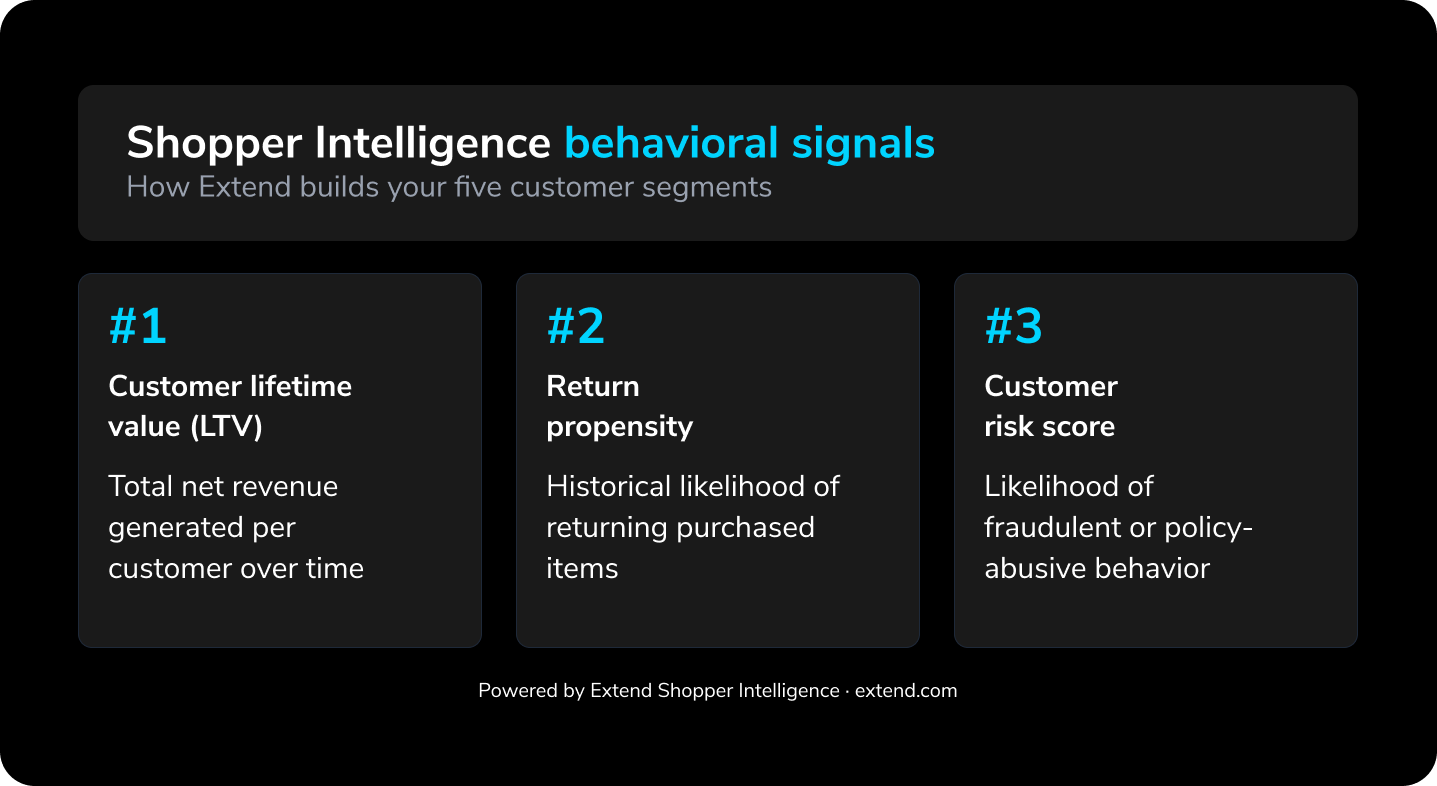
Using these inputs, Shopper Intelligence assigns customers to one of the five segments and applies the appropriate policies across delivery, returns, and claims. And because these inputs update continuously as new data becomes available, the segments evolve as customer behavior evolves. For example, a single purchaser flows seamlessly into the standard customer segment once they meet the criteria.
Turn ecommerce customer segmentation into a genuine competitive advantage
Online retailers like you know you can’t treat all customers the same way. With Extend Shopper Intelligence, you have a powerful tool to act on that knowledge at scale.
Turn behavioral data into dynamic policies that deploy automatically, across every customer touchpoint, with much less manual intervention. Your operational costs go down, while the shopping experience gradually improves.
Even better, Shopper Intelligence is available to ecommerce businesses across all product categories. Get in touch with the Extend team today to learn more.

Aaron Sullivan is content and copy director at Extend. He specializes in writing about e-commerce, finance, entertainment, and B2B SaaS.